When the Powerwalls Went to Zero: Turning a Tesla Recall Into a Home-Energy Upgrade
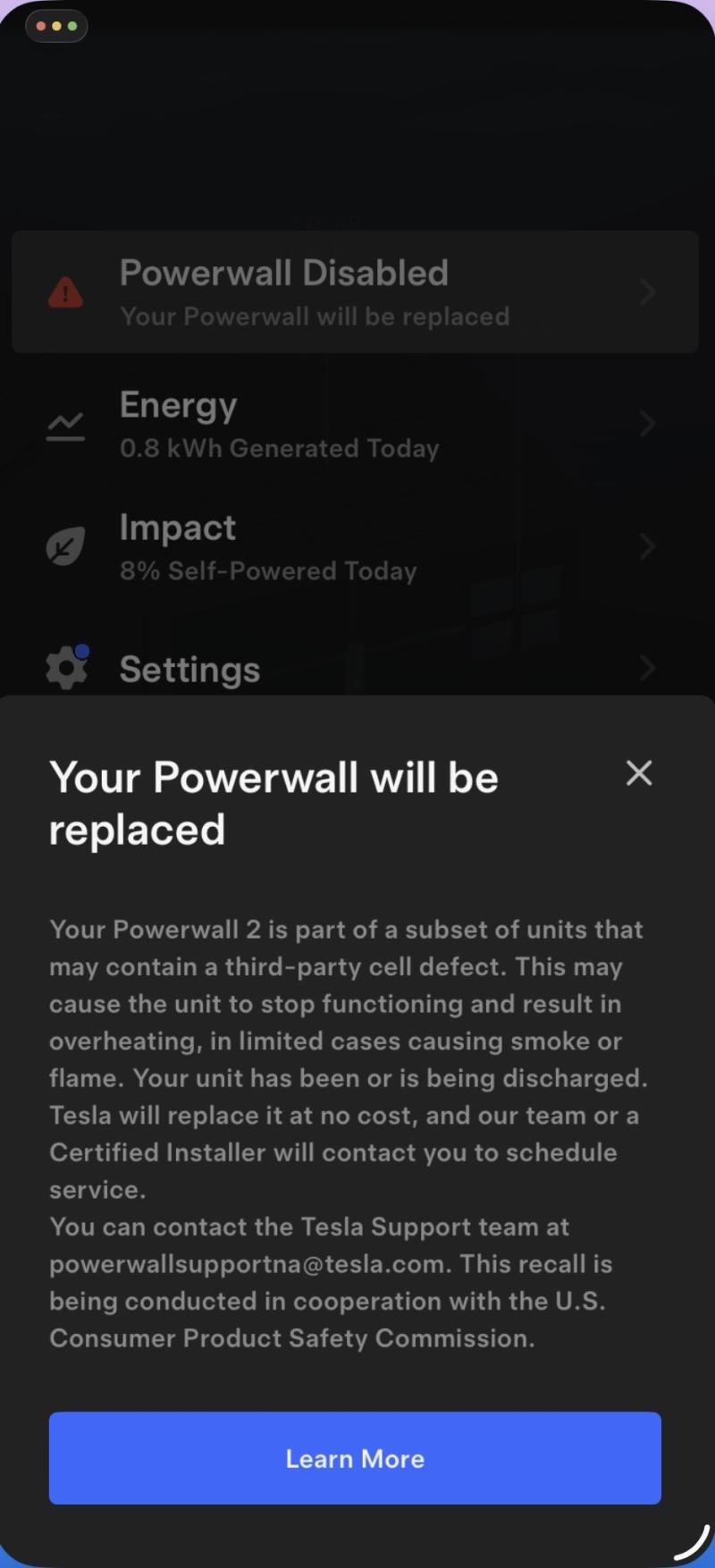
On September 2, 2026, we woke up to an unwelcome message in the Tesla app:
“Powerwall Disabled — Your Powerwall will be replaced.”
Both of our Powerwall 2 batteries showed 0%. Tesla had remotely disabled them because they were part of a group of Powerwall 2 units that may contain a defective third-party battery cell. The message explained that the defect could cause a unit to stop functioning and, in limited cases, overheat, smoke or catch fire. Tesla would replace the affected Powerwalls at no cost.
We were not completely caught off guard. Reddit forums and YouTube had plenty of content that gave us a heads up that this was coming.
For us, losing the batteries is considerably more significant than simply losing a way to save a little money on electricity.
Why we depend on our Powerwalls
We live in the Santa Cruz Mountains on a single-lane road. Power outages are part of living here. We also face PG&E Public Safety Power Shutoffs during periods of high wildfire risk. And, the CZU lighting complex fire had us evacuated for several weeks exactly six years ago.
And when something actually breaks, restoration can take time. Getting utility crews and equipment into mountain neighborhoods isn’t always as straightforward as repairing an outage in town.
Our solar and Powerwall system therefore isn’t just about electricity rates. It is part of the house’s resilience infrastructure.
We installed two Powerwall 2s in late 2020. Together they provide about 27 kWh of usable battery storage. During a normal sunny day, the solar panels run the house while charging the batteries. Once the batteries are full, excess production goes to the grid. As solar production falls later in the day, the Powerwalls take over.
We’ve become accustomed to the house quietly moving between solar, battery and grid power without much intervention.
Suddenly, that part of the system was gone.
We were using those batteries—a lot
The recall also prompted us to take a closer look at how we actually use the system.
The numbers were revealing.
In June 2026, before we began regularly charging an EV at home, our Powerwalls:
- charged 510.8 kWh
- discharged 435.2 kWh
That’s an average discharge of about 14.5 kWh every day from a 27-kWh battery system.
Our solar array generated 1,397.7 kWh that month. Of that production:
- 399.3 kWh went directly to the house
- 509.5 kWh went into the Powerwalls
- 488.9 kWh went back to the grid
So even while substantially cycling two Powerwalls every day, we exported almost 489 kWh of excess solar in a single month.
That caught our attention.
Then we added an EV
We installed our home EV charger in July, so August provides a useful first full month of data with EV charging included.
In August 2026, the house used 1,860.5 kWh of electricity—about 60 kWh per day.
Our solar system generated 1,289.2 kWh.
The Powerwalls charged 551.1 kWh and discharged 474.1 kWh. Of the energy used to charge them, 96 percent came from solar.
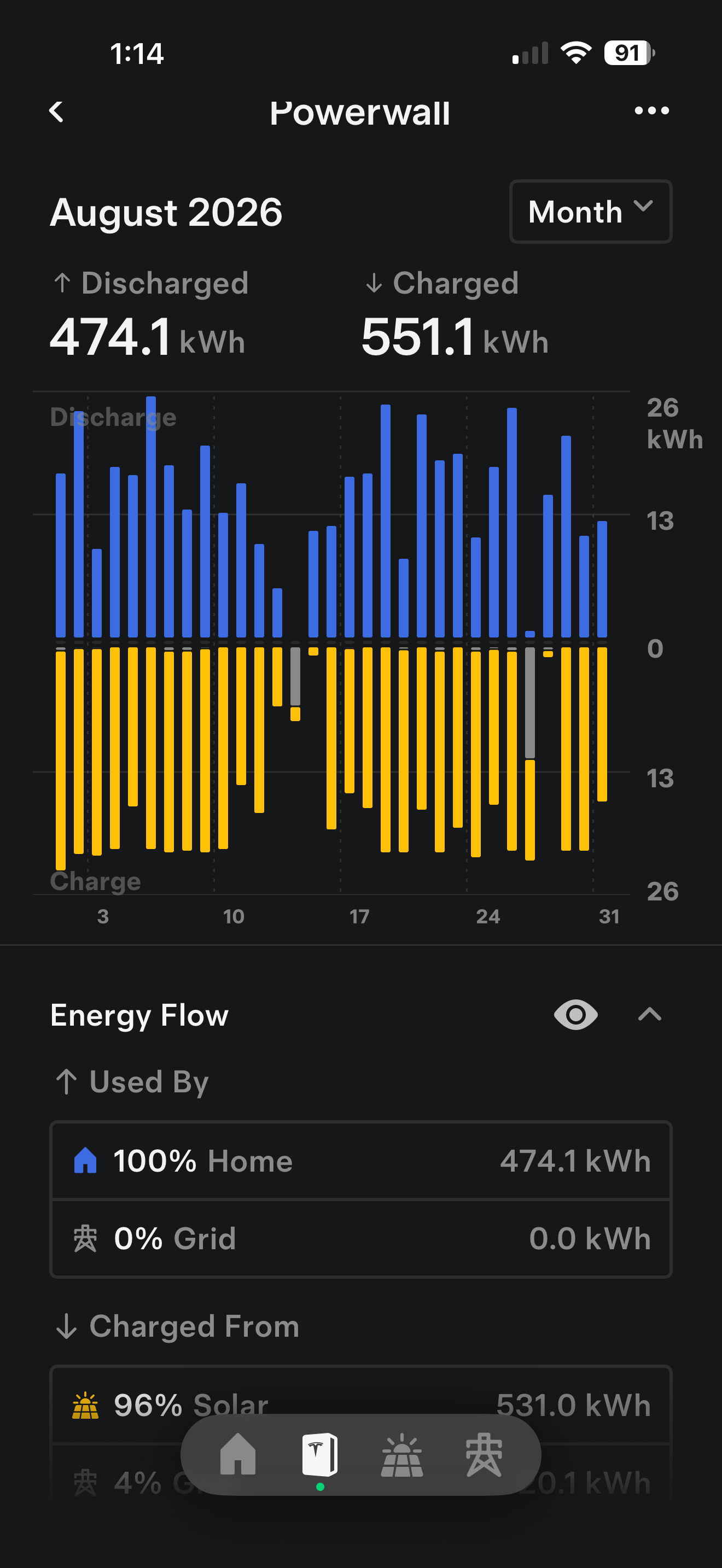
Despite adding the EV, the batteries were still cycling at almost the same rate as they had before:
June: 14.5 kWh/day discharged
August: 15.3 kWh/day discharged
The EV hadn’t suddenly created our heavy Powerwall usage. We were already using the batteries extensively.
What did change was what happened to some of our excess solar.
In June, 488.9 kWh went to the grid.
In August, that dropped to 304.3 kWh.
That’s encouraging. The EV is consuming some energy that otherwise would have been exported.
But we’re still exporting nearly 10 kWh of solar per day on average while importing electricity at other times.
That led to an obvious question:
If Tesla has to replace our batteries anyway, is this the right time to increase our storage?
From Powerwall 2 to Powerwall 3
Our original solar installer, Allterra Solar in Santa Cruz, had already handled several of these replacements.
We contacted them when the warning appeared. Our Service Manager began the replacement process and confirmed that Tesla is replacing affected Powerwall 2s with Powerwall 3 equipment.
That creates an unusual opportunity.
We have two Powerwall 2s. Greg believes Tesla will provide two full Powerwall 3s if Allterra requests them, and he sees no downside to doing that provided we have adequate physical space.
Fortunately, space isn’t a problem. Our two existing Powerwalls sit on a large concrete patio alongside the house, with considerable room available for additional equipment.
We’ve therefore asked Allterra to use two full Powerwall 3s as the baseline for the new system.
That’s an important distinction.
Two Powerwall 3s would still give us 27 kWh of storage, essentially replacing the capacity we have today. But their substantially greater power output would give the house much more instantaneous battery power than our two Powerwall 2s provide.
That means we probably don’t need a third full Powerwall 3 merely to increase output.
Instead, we can concentrate our expansion dollars on what we actually want:
more stored energy.
How much storage?
Powerwall 3 introduces another useful option: the Powerwall 3 Expansion battery.
An Expansion adds another 13.5 kWh of energy storage without adding another complete Powerwall inverter. That makes it particularly interesting for our installation.
Assuming Tesla supplies the two full PW3s, we’re currently considering something along these lines:
| Configuration | Total Storage |
|---|---|
| 2 Powerwall 3s | 27 kWh |
| 2 PW3 + 1 Expansion | 40.5 kWh |
| 2 PW3 + 2 Expansions | 54 kWh |
| 2 PW3 + 3 Expansions | 67.5 kWh |
We’re not ready to make that decision yet. Allterra’s electricians and design team need to determine what the existing electrical installation will accommodate and what permitting and PG&E interconnection work an expansion would require.
But 54 kWh is emerging as the configuration we’re most interested in evaluating.
It would double the storage capacity of our existing system.
Why 54 kWh looks interesting
There’s an economic argument for additional storage because we’re already exporting substantial amounts of solar energy.
But economics aren’t the only consideration—and probably aren’t even the most important one for us.
Think about a prolonged outage. Given that PG&E shuts power off every time a squirrel farts or a branch hits a line, a downed tree in an El Niño year could be a week.
With 27 kWh available, there isn’t actually 27 kWh to casually consume every day. You need to account for remaining battery reserve, variable solar production and the possibility that tomorrow will be cloudy.
At 54 kWh, we could be much more conservative about energy use while maintaining a significantly larger reserve.
And solar changes the equation considerably.
Our August system averaged about 41.6 kWh of solar production per day. On a good summer day, that’s potentially enough energy to operate a carefully managed house while replenishing batteries.
The difficult scenario isn’t a sunny 24-hour outage.
It’s a PSPS or equipment failure followed by several days of marginal solar production.
That’s the scenario we’re designing around.
What about the EVs?
We currently have one EV and expect to add another next year.
Initially that sounded like an argument for enormous battery output: two EV chargers plus the house.
It isn’t.
We have no reason to charge two vehicles simultaneously. Charging can be scheduled, and during a prolonged outage EV charging becomes a discretionary load.
Our priority would be:
House first. Battery reserve second. EV charging when sufficient solar is available.
We aren’t planning to empty 54 kWh of stationary batteries into a much larger EV battery during an outage.
Under normal conditions, however, the EV gives us another useful destination for daytime solar that would otherwise be exported.
An unexpected opportunity
We certainly wouldn’t have chosen to have our Powerwalls remotely disabled.
At the moment, the system that we installed specifically to protect us from outages can’t perform that job. Until the replacement happens, we’re back to depending on the grid and our portable generator when the power fails. Today that is a duel fuel generator connected to our propane tank.
But the recall has also forced us to look closely at six years of experience with residential batteries.
The conclusion is fairly clear:
We use them. They had about 4% degradation over their busy lives.
They’re not sitting on the wall waiting for an emergency. During normal operation we’re routinely cycling more than half of their capacity. Our solar array is simultaneously producing enough surplus energy that hundreds of kilowatt-hours still go back to the grid during good solar months.
And our location gives stored energy a value that isn’t completely captured by calculating the retail price of a kilowatt-hour.
So rather than simply replacing two Powerwall 2s with the equivalent amount of storage and calling the project finished, we’re looking at the recall as an opportunity to redesign the system around what we’ve learned since 2020.
The first step is now underway: two full Powerwall 3s as the replacement baseline.
The next question is whether we stop at 27 kWh, increase to 40.5 kWh, or—as we’re increasingly inclined to do—build a 54-kWh system designed around several days of mountain-home resilience.
Once Allterra comes back with the engineering options and costs, we’ll have the next part of the story.